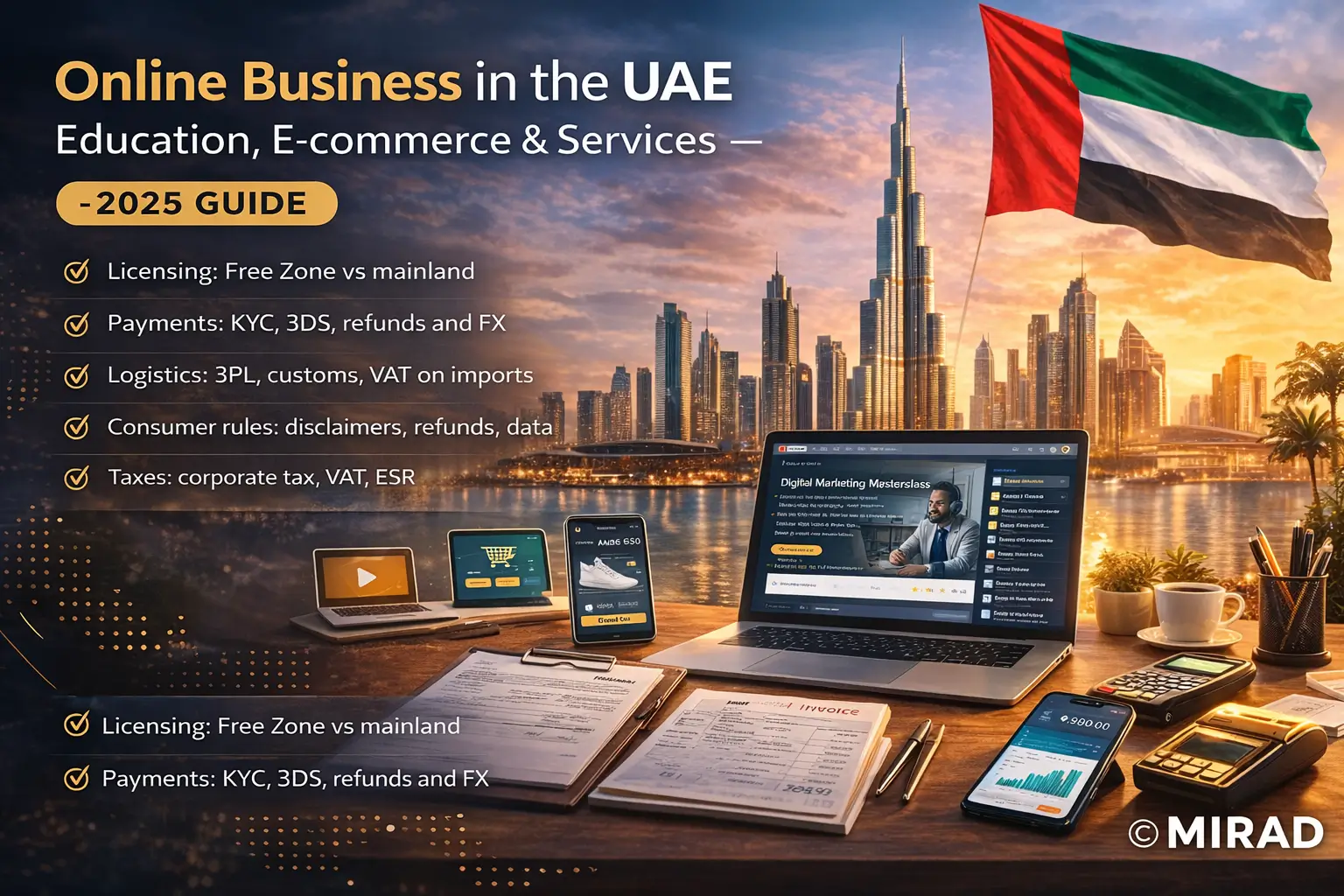
Online Business in the UAE: Education, E-commerce & Services - 2025 Guide
Online Business in the UAE: Education, E-commerce & Services — 2025 Guide
Building an online business from the UAE gives founders a strategic hub for cross-border sales, remote delivery, and digital products. This guide maps the three dominant models—Education (courses, coaching, academies), E-commerce (D2C, marketplaces, dropship/3PL), and Online Services (consulting, SaaS, agencies)—and explains licensing choices, payments, KYC/AML, logistics, data protection, consumer rules, and tax touchpoints (VAT, corporate tax, ESR). Use the checklists and tables to design a compliant, bank-ready structure that scales globally.
Pick the legal route first (Free Zone vs mainland) based on activities, payments, and on-shore plans.
Payment success depends on clean KYC, refunds/chargeback policy, and clear customer T&Cs.
For e-commerce, plan SKU data, 3PL/warehouse, customs & VAT on imports, and returns workflow.
Education offers often require proper disclaimers; regulated diplomas may need approvals.
Services/SaaS need airtight statements of work, DPAs, and IP ownership terms.
ESR/substance can affect incentives; keep governance evidence and basic books.
Banks favor transparent models with documented clients, traffic, and cash-flow logic.
Business models: Education vs E-commerce vs Services
Model
What you sell
Key enablers
Watch-outs
Education
Courses, cohorts, webinars, coaching
LMS, live tools, certificates, community
Claims & outcomes, refunds, accreditation language
E-commerce
Physical goods D2C/marketplaces
Catalog, payments, 3PL/warehouse, returns
Customs/VAT, product compliance, warranties
Online Services/SaaS
Consulting, retainers, software access
Proposals, SOWs, ticketing, SLAs, MSA/DPA
Scope creep, IP ownership, data processing
How to launch: step-by-step
Payments & gateways: what matters
Area
Why it matters
Practical tip
Underwriting/KYC
Gateways assess product risk & refunds
Publish clear T&Cs, delivery timelines, and a visible refund policy
3D Secure/SCA
Reduces fraud & chargebacks
Enable 3DS, use risk rules, monitor decline codes
Settlement & currency
FX costs & cash-flow timing
Match billing to customer currency; batch settlements
Chargebacks
Disputes can lock accounts
Keep proof of delivery/attendance; fast support responses
License & corporate docs: ~2–5 business days (popular zones & activities).
Gateway underwriting: ~5–15 business days; faster with complete KYC and policies.
Site & stack go-live: ~1–3 weeks depending on catalog/checkout/LMS complexity.
First settlements: typically weekly; monitor dispute ratios < 1% monthly.
Bank account: ~1–4 weeks; bring SOF/SOR and sample pipeline/contracts.
Own store vs marketplaces
Channel
Pros
Cons
Good for
Own store
Control brand, data, margins; flexible funnels
Must source traffic; handle all ops/support
D2C brands, subscriptions, bundles
Marketplaces
Built-in traffic; trust & logistics programs
Fees, policy risk, intense price competition
Commodity SKUs, new market testing
Hybrid
Broader reach; diversify risk
More tooling & coordination work
Scale stage; regional expansion
Common pitfalls & how to avoid them
License codes don’t match activities → banking friction; align early.
No refunds/returns page → gateway underwriters flag risk; publish clear policy.
Ambiguous T&Cs/privacy → disputes and fines; use plain language templates.
Underestimating landed cost → negative margins at scale; model per-SKU unit economics.
Missing DPAs and vendor security → procurement blocks in B2B sales; prepare a security pack.
Taxes & compliance overview
Corporate tax (baseline 9%) applies to UAE-sourced profits above thresholds; Free Zone incentives may apply to qualifying income subject to substance and conditions. VAT registration is required when making taxable supplies in the UAE above threshold or voluntarily for specific models (e.g., frequent imports). Keep basic books, contracts, and inventory records; file ESR notifications/reports when in scope. International founders should confirm any home-country filings for foreign companies and accounts.
FAQs
Do I need a physical office for an online business? Many zones accept flexi/virtual desks; check activity rules.
Which gateway works best? It depends on risk profile, currencies, and dispute ratios—opt for 3DS and clear T&Cs.
Can I dropship from outside the UAE? Yes, but manage customs, duties, delivery times, and returns transparency.
Are webinars/cohorts regulated? Content is generally free, but avoid professional/medical/financial misrepresentation.
How to price VAT? If supplying in the UAE, check VAT registration and treatment; imports may trigger VAT.
Can I bill in USD/EUR? Many gateways support multi-currency; align with bank settlement and FX fees.
What proves substance? Local management, decision logs, contracts, staff/outsourcing, and office arrangements.
How fast can I open a bank account? ~1–4 weeks with strong documentation, live site, and client pipeline.
Can I sell on marketplaces and my site? Yes; ensure unified stock, pricing logic, and returns handling.
Is SaaS taxed differently? Tax depends on supply location and rules; review VAT and corporate tax positions.
Disclaimer: Information only—not tax, legal, or financial advice. Regulations and gateway policies change; verify current requirements for your activities and consult qualified advisors.